5.3. [ Source ] section
The source information can be set in this section. The source type is specified by the number s-type=N based on its geometry as in Table 5.3.1 .
The energy of the source particle can be given by e0 for mono-energy or e-type for energy spectrum. [1] Unit of energy in [source] is MeV/n (MeV per nucleons) except for particles not the constitute of nucleon (photons, electrons, pions, muons etc).
source type |
explanation |
|---|---|
s-type = 1, (4) |
Cylinder (or circle, pencil) |
s-type = 2, (5) |
Rectangular solid (or rectangle) |
s-type = 3, (6) |
Gaussian (\(x,y,z\) independent) |
s-type = 7, (8) |
Generic parabola (\(x,y,z\) independent) |
s-type = 9, (10) |
Sphere or spherical shell |
s-type = 11 |
Phase-space source based on accelerator beam emittance. |
s-type = 12 |
Reading the data from decay-turtle output |
s-type = 13, (14) |
Gaussian (\(xy\) plane) |
s-type = 15, (16) |
Generic parabola (\(xy\) plane) |
s-type = 17 |
Reading dump file |
s-type = 18, (19) |
Cone |
s-type = 20, (21) |
Triangle prism |
s-type = 22, (23) |
\(xyz\)-mesh distribution |
s-type = 24 |
Tetra-mesh source |
s-type = 26 |
Surface definition source |
s-type = 100 |
User definition source. Edit the usrsors.f and compile PHITS. |
In Table 5.3.1, numbers in the brackets were used until ver. 2.94. If both e0 and e-type are defined from ver. 2.95, the energy is decided according to the previous procedure of s-type. For example, e0 is used when s-type = 1, and the definition of e-type is used when s-type = 4.
The projectile direction is specified by three parameters: dir, phi, and dom. The relation between these is shown in Fig. 5.3.1, in which the direction is noted as a thick arrow. dir is the direction cosine relative to the \(z\) axis. phi is the azimuthal angle from the \(x\) axis and is given in degrees; if not set by the user, the value of the azimuthal cosine is selected randomly. Using the parameter dom spreads the direction determined by dir and phi by the solid angle \(2\pi(1-\cos\psi)\), where \(\psi =\) dom (in degrees). In the PHITS calculation, the angle is selected randomly within the solid angle.
By setting dir = all, the direction of the source beam becomes isotropic. To use a specific angular distribution, a subsection in the distribution based on numerical data or an analytic function starting from a-type is required.
In s-type = 9, the definition of dir differs. In s-type = 11 and 12, dir can only be set to \(-1\) or \(1\).
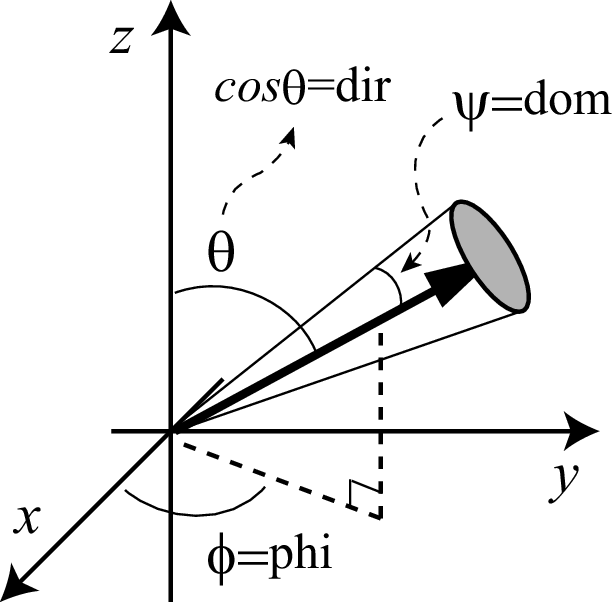
Fig. 5.3.1 Source direction and parameters dir, phi, dom .
- 5.3.1. <source>: Multi-source
- 5.3.2. Common parameters
- 5.3.3. Cylindrical source
- 5.3.4. Rectangular solid source
- 5.3.5. Gaussian source (x, y, z independent)
- 5.3.6. Generic parabola source (x, y, z independent)
- 5.3.7. Gaussian source (x-y plane)
- 5.3.8. Generic parabola source (x-y plane)
- 5.3.9. Sphere and spherical shell source
- 5.3.10. Phase-space source based on accelerator beam emittance
- 5.3.11. s-type = 12 source
- 5.3.12. Cone source
- 5.3.13. Triangle prism source
- 5.3.14. xyz-mesh distribution source
- 5.3.15. Tetra-mesh source
- 5.3.16. Surface definition source
- 5.3.17. Dump file source
- 5.3.18. User-defined source
- 5.3.19. Definition of energy distribution
- 5.3.19.1. Continuous energy distribution with integral value
- 5.3.19.2. Continuous energy distribution with differential value
- 5.3.19.3. Continuous energy distribution with double (energy & angular) differential type
- 5.3.19.4. Discrete energy distribution
- 5.3.19.5. Energy distribution by free format
- 5.3.19.6. Gaussian and Maxwellian energy distributions
- 5.3.19.7. Energy distribution defined by analytical functions
- 5.3.19.8. Energy distribution of RI source
- 5.3.19.9. Energy distribution of tally results
- 5.3.19.10. Cosmic-ray source mode
- 5.3.20. Definition of angular distribution
- 5.3.21. Definition of time distribution
- 5.3.22. Examples of multi-source
- 5.3.23. Duct source option