5.3.10. Phase-space source based on accelerator beam emittance
In this mode, sources are defined based on the phase space vertical to the beam axis. This mode is useful for reproducing accelerator sources when the RMS emittance is known. Note that the RMS emittance is not normalized by energy. The parameters used for defining the phase-space source are shown below. The order of parameters is free. Parameters with (D=***) are optional.
value |
explanation |
(D=0.0) |
x coordinate of the beam center [cm]. |
value |
explanation |
(D=0.0) |
y coordinate of the beam center [cm]. |
value |
explanation |
(D=0.0) |
Minimum z [cm]. |
value |
explanation |
(D=0.0) |
Maximum z [cm]. |
value |
explanation |
(D=0.0) |
Gradient of the ellipse in phase space in the x direction [rad]. |
value |
explanation |
(D=0.0) |
Gradient of the ellipse in phase space in the y direction [rad]. |
value |
explanation |
(D=0.0) |
Sampling method from the phase space. |
wem > 0 |
Uniform distribution. wem represents the RMS emittance in pi cm mrad. |
wem = 0 |
Gaussian distribution. |
value |
explanation |
(D=0.0) |
Ratio of maximum coordinate and angle in cm/mrad for the x-axis when wem > 0, or sigma of the Gaussian distribution of the x coordinate in cm for rx = 0 when wem = 0. |
value |
explanation |
(D=0.0) |
Ratio of maximum coordinate and angle in cm/mrad for the y-axis when wem > 0, or sigma of the Gaussian distribution of the y coordinate in cm for ry = 0 when wem = 0. |
value |
explanation |
(D=0.0) |
Sigma of the Gaussian distribution of the x angle in mrad for rx = 0. Effective only when wem = 0. |
value |
explanation |
(D=0.0) |
Sigma of the Gaussian distribution of the y angle in mrad for ry = 0. Effective only when wem = 0. |
value |
explanation |
(D=0.0) |
Center of the phase-space x coordinate in cm. |
value |
explanation |
(D=0.0) |
Center of the phase-space y coordinate in cm. |
value |
explanation |
(D=0.0) |
Center of the phase-space x angle in mrad. |
value |
explanation |
(D=0.0) |
Center of the phase-space y angle in mrad. |
value |
explanation |
(D=1) |
Direction cosine. Only 1 or -1 can be set. |
value |
explanation |
For mono-energy source, specify the projectile energy [MeV/n]. For an energy spectrum, use e-type = instead. |
value |
explanation |
mono-energy source |
Give the source energy [MeV/n] directly by e0. |
energy spectrum |
Specify the source energy distribution by e-type. |
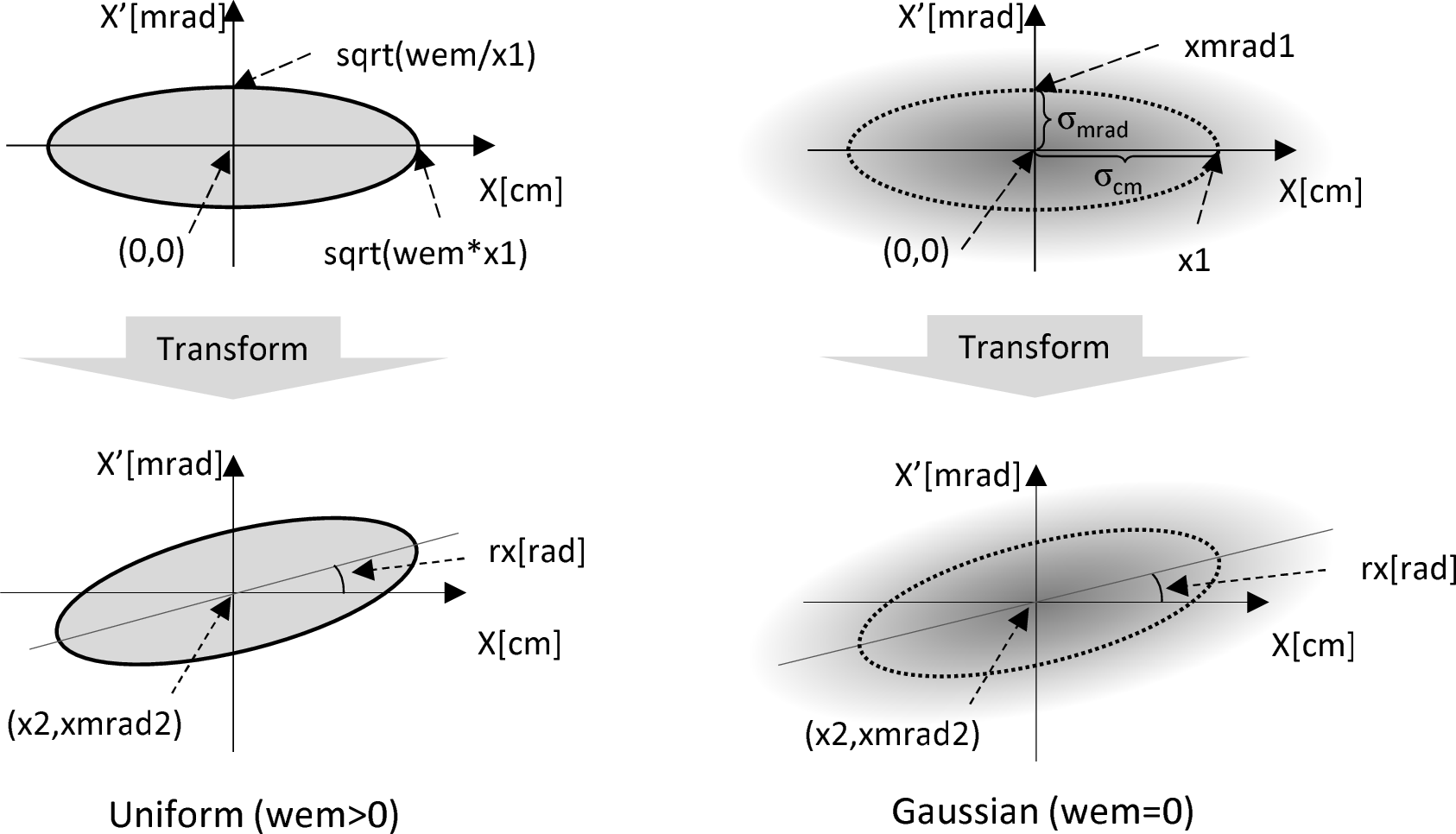
Fig. 5.3.3 Sampling method from the phase space of x-coordinate, X, and angle, X’.
After considering the gradient and center of the phase space, the sampled coordinates of \((X, X^\prime)\) and \((Y, Y^\prime)\) are transformed to \((X_m, X_m^\prime)\) and \((Y_m, Y_m^\prime)\) as follows.
The position \((x, y)\) and the direction vector \((u, v, w)\) of the source particle are determined from the following equations in the case of dir = 1.0.
When wem = 0, a two-dimensional Gaussian distribution that covers the elliptical area represented by the RMS of a distance and the RMS of an angle on the phase-space diagram is set. At wem > 0, source particles are generated within the ellipse on the phase space. This source with wem > 0 differs from a general beam distribution because it produces particles with a uniform distribution on the ellipse in the phase space. To reproduce the accelerator beam, you should generate a particle source of arbitrary emittance shape with wem = 0.