5.3.9. Sphere and spherical shell source
The parameters for sphere and spherical shell sources are shown below. The order of parameters is free. Parameters with (D=***) are optional.
value |
explanation |
(D=0.0) |
x coordinate of the sphere center [cm]. |
value |
explanation |
(D=0.0) |
y coordinate of the sphere center [cm]. |
value |
explanation |
(D=0.0) |
z coordinate of the sphere center [cm]. |
value |
explanation |
(D=0.0) |
Inner radius [cm]. When r1 = 0, this becomes a sphere source. |
value |
explanation |
(D=0.0) |
Outer radius [cm]. |
value |
explanation |
(D=1.0) |
Direction option for the spherical source. |
[-1,1] |
Direction cosine relative to the outward normal from the sphere center. |
data |
An a-type subsection is required. |
all |
Isotropic distribution from a spherical shell region. |
-all |
Cosine-biased irradiation toward the inside. |
iso |
Isotropic irradiation to every point inside the sphere. |
value |
explanation |
Lower limit of the polar angle range [degree]. |
value |
explanation |
Upper limit of the polar angle range [degree]. |
value |
explanation |
Lower limit of the azimuthal angle range [degree]. |
value |
explanation |
Upper limit of the azimuthal angle range [degree]. |
value |
explanation |
(D=0) |
Option for angular bias treatment. |
0 |
Particles outside the requested angular range are killed immediately. |
1 |
PHITS resamples until the requested angular condition is satisfied. |
value |
explanation |
For mono-energy source, specify the projectile energy [MeV/n]. For an energy spectrum, use e-type = instead. |
value |
explanation |
mono-energy source |
Give the source energy [MeV/n] directly by e0. |
energy spectrum |
Specify the source energy distribution by e-type. |
When you want to isotropically irradiate objects within a certain sphere with radius r1, set dir = -all (or iso) and r1 = r2. In this case, the fluences at all locations inside the sphere will be \(1/\pi/(r1)^2\). Source generation locations are uniformly distributed within the spherical shell with inner and outer radii of r1 and r2, respectively. Thus, r1 should be smaller than or equal to r2 except for dir = iso, where r1 should be equal to or larger than r2. Please note that, in this case, r1 and r2 do not represent the inner and outer radii, respectively.
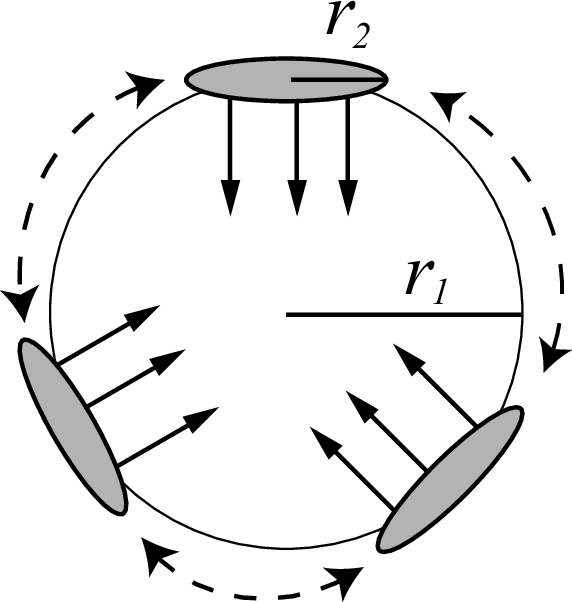
Fig. 5.3.2 Schematic of the source in the case of dir = iso. The actual source generation points are always on the sphere with radius of r1.
When a particle with angle below ag1/pg1 or above ag2/pg2 is sampled in the case of isbias = 0, it is converted to photon with no energy in order to kill the particles immediately after their generation, i.e. it is counted as a source particle even though it is not transported at all. Thus, these parameters are useful for reducing the computational time by terminating particles from unwanted directions. Since this method can be regarded as a kind of variance reduction technique, the normalization factor totfact does not have to be changed. For example, totfact should be set to the area of the source circle, \(\pi*r2^2\), to obtain the normalized tally results per unit fluence irradiation (/cm \(^2\)), irrespective of ag1 and ag2. In the case of isbias = 1, PHITS continuously resamples a new particle until the sampled angle meets the request by ag1, ag2, pg1, and pg2. Thus, you can reduce the computational time, but you have to calculate the success rate of the angle sampling and multiply that value by totfact yourself.