5.2.3. Cut-off and switching energies
Value |
Explanation |
(D=1.0e-3)
|
(i=1)Proton cut-off energy [MeV].
|
(D=1.0e-11)
|
(i=2)Neutron cut-off energy [MeV].
|
(D=1.0e-3)
|
(i=3,4,6-10)Cut-off energy for pion+, pion0, muons, and kaons [MeV].
|
(D=1.0)
|
(i=5)Pion- cut-off energy [MeV]. If you set emin(5)<1 MeV, absorption of pion- does not occur at stopping by energy cut-off.
|
(D=1.0)
|
(i=11)Cut-off energy for particle species with itype=11 [MeV].
|
(D=1.0e+9)
|
(i=12,13)Cut-off energy for electrons (i=12), positrons (i=13) [MeV].
|
(D=1.0e-3)
|
(i=14)Cutt-off energy for photons [MeV].
|
(D=1.0e-3)
|
(i=15-19)Cut-off energy for deuterons (i=15), tritons (i=16), \(^3\) He (i=17), \(^4\) He (i=18), and nuclei (i=19)[MeV/n]. Here, MeV/n means MeV per nucleon.
i=particle id; see Section 4.7 .
|
Value |
Explanation |
(D=emin(i))
|
(i=1,12,13,15,18)Upper energy limit of atomic (i=12,13) or nuclear data (i=1,15,18) library use for i-th particle in MeV (or MeV/n for deuteron and \(\alpha\) particle). Note that cross section data library for i=3-11,16,17,19 cannot be used in PHITS. Please see APPENDIX Section 13.3 in more detail.
|
(D=20.0)
|
(i=2)Upper energy limit of nuclear data library use for neutrons [MeV].
|
(D=1.0e+3)
|
(i=14)Upper energy limit of atomic library use for photons [MeV].
Note that the user has to prepare the data library except for dmax(i=2,12,13,14), which are included in the PHITS package.
|
Value |
Explanation |
(D=0.001)
|
Upper energy limit of photo-nuclear data library in MeV. Note that dmax(14) is the upper energy limit of photo-atomic data library.
|
Value |
Explanation |
The suffix ID (file extension name) of the default nuclear data library file for particle type i. Note that lib(2) is effective only for dmax(2)>20. If the nuclear data libraries are not available for certain nuclides specified in [material], except for neutron, PHITS automatically employs the nuclear reaction models for the nuclides. For neutron, the conventional nuclear data libraries specified at the top of the address file (JENDL-4.0 in the case of “xsdir.jnd”) are selected.
|
|
(D=20h)
|
(i=1) Suffix ID of the default proton nuclear data library. 20h indicates JENDL-5 [1]
|
(D=20c)
|
(i=2) Suffix ID of the default high-energy neutron nuclear data library with dmax(2) above 20 MeV.
|
(D=20u)
|
(i=14) Suffix ID of the default photo-nuclear data library. 20u indicates JENDL-5.
|
(D=20o)
|
(i=15) Suffix ID of the default deuteron nuclear data library. 20o indicates JENDL-5.
|
(D=20a)
|
(i=18) Suffix ID Of the default alpha-induced nuclear data library. 20a indicates JENDL-5.
|
Value |
Explanation |
(D=0.001)
|
Lower energy limit for range calculation of charged particles [MeV/n].
|
Value |
Explanation |
(D=1000000)
|
Upper energy limit for range calculation of charged particles [MeV/n].
|
Value |
Explanation |
(D=1.0)
|
Reaction cut-off energy for i-th particle [MeV]. (The energy unit is MeV/n for i=15-19.) Any reactions ( \(\delta\) -ray productions are included) at energies below cmin(i) are not treated.
Note that the default values for neutron, electron, positron, and photon are emin(i). The default value for deuteron (i=15) is 0.001 MeV/n.
|
Value |
Explanation |
(D=1e-6)
|
Lower energy limit of electrons and positrons simulated by track structure mode [MeV].
|
Value |
Explanation |
(D=1e-2)
|
Upper energy limit of electrons and positrons simulated by track structure mode [MeV].
|
Value |
Explanation |
(D=1e-3)
|
Upper energy limit of protons and ions simulated by track structure mode [MeV/n]. If track-structure mode is not used, continuous-slowing approximation is applied. To perform proton and ion track structure simulation using your own PHITS executable file, please refer to Compilation with KURBUC in Section 10.
|
If values given by these parameters are referred to the upper boundaries of a range, then the given values are not included in the range. If values given by the parameters are referred to the lower boundaries of a range, then the given values are included in the range. For example, a proton right at the emin(1) energy is not cut-off as the cut-off range is \(\geqslant\) 0 and \(<\) emin.
When the kinetic energy of a transport particle is less than emin, the energy cut-off is performed and then its transport calculation is stopped. In this case, the residual kinetic energy is deposited locally at that place, and the particle decays in accordance with decay modes shown in Table 4.7.3 except for neutrons. If the particle species is positron, annihilation occurs instead of decay.
For electrons and positrons, however, particles generated in vacuum below the cut-off energy are not terminated immediately; The cut-off by emin is applied only when energy loss occurs in material. This treatment is used to accurately calculate the position where a positron annihilates.
PHITS uses libraries in the energy region emin \(<\) energy \(<\) dmax. If emin > dmax is set, no libraries are used. The upper energy limits for the use of data libraries are 20 MeV and 100 GeV, respectively for neutron and photon. When EGS5 is not used, the upper energy limits for electrons and positrons are 10 GeV. The default setting of emin(12-14) is automatically adjusted by the negs option; e.g., emin(14)=0.001 if negs=-1. The default settings of emin(2) and dmax(2) are automatically adjusted by the nucdata option; e.g., emin(2)=1.0e-11 if nucdata=1. See Table 5.2.28 for both settings in more details.
The range table of charged particles is set within esmin \(<\) energy \(<\) esmax. To use a significantly higher energy, the user should set esmax.
The minimum cut-off energy for charged particles, emin, cannot be set lower than esmin. In such cases, emin is automatically adjusted to esmin.
When [Frag Data] is used, cmin(i) should be set to the minimum incident energy of the defined cross sections.
etsmin>1e-9 (1 meV) can be set. But the setting below 1e-6 (1 eV) is not recommend because computational time becomes extremely long.
etsmax>1e-3 (1 keV) must be set. The setting this parameter below 0.1 (100 keV) is recommend, otherwise the computational time becomes extremely long.
For the track structure mode, emin(12) and emin(13) should be set to 1.0e-3, and EGS5 should be activated (negs=1,2).
Value |
Explanation |
(D=-1)
|
Option for electron, positron, and photon transport.
|
=-1
|
Transport only photons based on the PHITS original algorithm. By selecting this option, emin(14) and dmax(14) are automatically set to 0.001 and 1000.0, respectively. If these parameters are directly specified in the input file, the specified parameters overwrite the setting.
|
=0
|
Ignore electron, positron, and photon transport. With this setting, emin(12-14)=dmax(12-14)=1.0e+9.
|
=1
|
Transport electrons, positrons, and photons based on the EGS5 algorithm. By setting this option, emin(12,13) and emin(14) are automatically set to 0.1 and 0.001, respectively, while dmax(12-14) are set to 1000.0. If these parameters are directly specified in the input file, the specified parameters overwrite the setting. file(1) or file(20) must be specified in this option.
|
=2
|
Same as negs=1, but the maximum energies for electron, positron, and photon, dmax(12-14), are automatically set to 10 TeV (1e+7).
|
Value |
Explanation |
(D=1)
|
Option for automatic setting of emin(2) and dmax(2) for the usage of nuclear data library.
|
=0
|
No adjustment (nuclear data are not used). With this setting, emin(2)=dmax(2)=1.0e-3.
|
=1
|
Change the parameters suitable for JENDL-4.0, i.e. emin(2)=1.0e-11 and dmax(2)=20.0. If these parameters are directly specified in the input file, the specified parameters overwrite the setting. file(1) or file(7) must be specified in this option.
|
Value |
Explanation |
(D=0)
|
Options for electron and positron transport.
|
=0
|
No slowing down and no reaction in the energy region above dmax(12).
|
=1
|
When the energy, \(e\) , is above dmax(12), the weight value, wgt, is changed to wgt \(=e/\) dmax(12), and then the transport calculation is performed with the energy of dmax(12).
|
When negs \(\ne\) 1,2 is set and the energies of electrons and positrons are between emin(12,13) and dmax(12,13), the original PHITS electron transport algorithm is used. However, please note that this algorithm is not recommended and its accuracy is not checked.
Value |
Explanation |
(D=20.)
|
Switching energy of nucleon-nucleus reaction calculation from Bertini (or JQMD) to JAM model [MeV].
|
Value |
Explanation |
(D=20.)
|
Switching energy of pion-nucleus reaction calculation from Bertini to JAM model [MeV].
|
Value |
Explanation |
(D=0.0)
|
Maximum energy [MeV] of isobar calculation when isobar is defined (isobar=1).
|
Value |
Explanation |
(D=0)
|
Options for the isobar model.
|
=0
|
Without isobar.
|
=1
|
With isobar.
|
Value |
Explanation |
(D=20.)
|
Switching energy of nucleon-nucleus reaction calculation from Bertini to JQMD model [MeV/n].
|
Value |
Explanation |
(D=10.0)
|
Minimum energy of JQMD calculation [MeV/n].
|
Value |
Explanation |
(D=3000.0)
|
Switching energy from JQMD to JAMQMD [MeV/n].
|
Value |
Explanation |
(D=1)
|
Control parameter for use of INCL.
|
=0
|
INCL is not used. For nucleon-induced reactions, JAM, JQMD, or Bertini model is used, depending on the values of ejamnu and eqmdnu. For pion-induced reactions, JAM or Bertini model is used, depending on the value of ejampi. For light-ion-induced reactions, JQMD is used.
|
=1
|
Use of INCL in a proton, neutron, pion, \(d, t, ^3\) He, or \(^4\) He induced reaction.
|
=2
|
Use of INCL in a proton, neutron, or pion induced reaction.
|
Value |
Explanation |
(D=1.0)
|
Minimum energy of INCL calculation [MeV/n].
|
Value |
Explanation |
(D=3000.0)
|
Maximum energy of INCL calculation [MeV/n].
|
Value |
Explanation |
(D=0)
|
Control parameter for use of INC-ELF in proton, neutron, and \(\alpha\) induced reactions.
|
=0
|
INC-ELF is not used.
|
=1
|
Use of INC-ELF in proton, neutron, and \(\alpha\) induced reactions.
|
=2
|
Use of INC-ELF in proton and neutron induced reactions.
|
Value |
Explanation |
(D=1.0)
|
Minimum energy of INC-ELF calculation [MeV].
|
Value |
Explanation |
(D=3500.0)
|
Maximum energy of INC-ELF calculation [MeV].
|
Value |
Explanation |
(D=0)
|
Control parameter for use of JQMD or JQMD-2.0.
|
=0
|
Use of JQMD in nuclear reactions.
|
=1
|
Use of JQMD-2.0 in nuclear reactions.
|
Below eqmdmin, the nuclear reactions of \(d, t, ^3\) He, \(\alpha\) , and nuclei are not treated by JQMD. As the applicability of JQMD is restricted in the low energy region and the range of nuclei is very low in the normal material, it is not necessary to consider the low energy reactions of nuclei for the usual case. As a default, high energy heavy ion collisions are treated by JAMQMD above 3.0 GeV/u. This switching energy can be changed by changing e jamqmd. It is possible to calculate even nucleon-induced collisions in JAMQMD by changing eqmdnu, ejamnu, and ejamqmd.
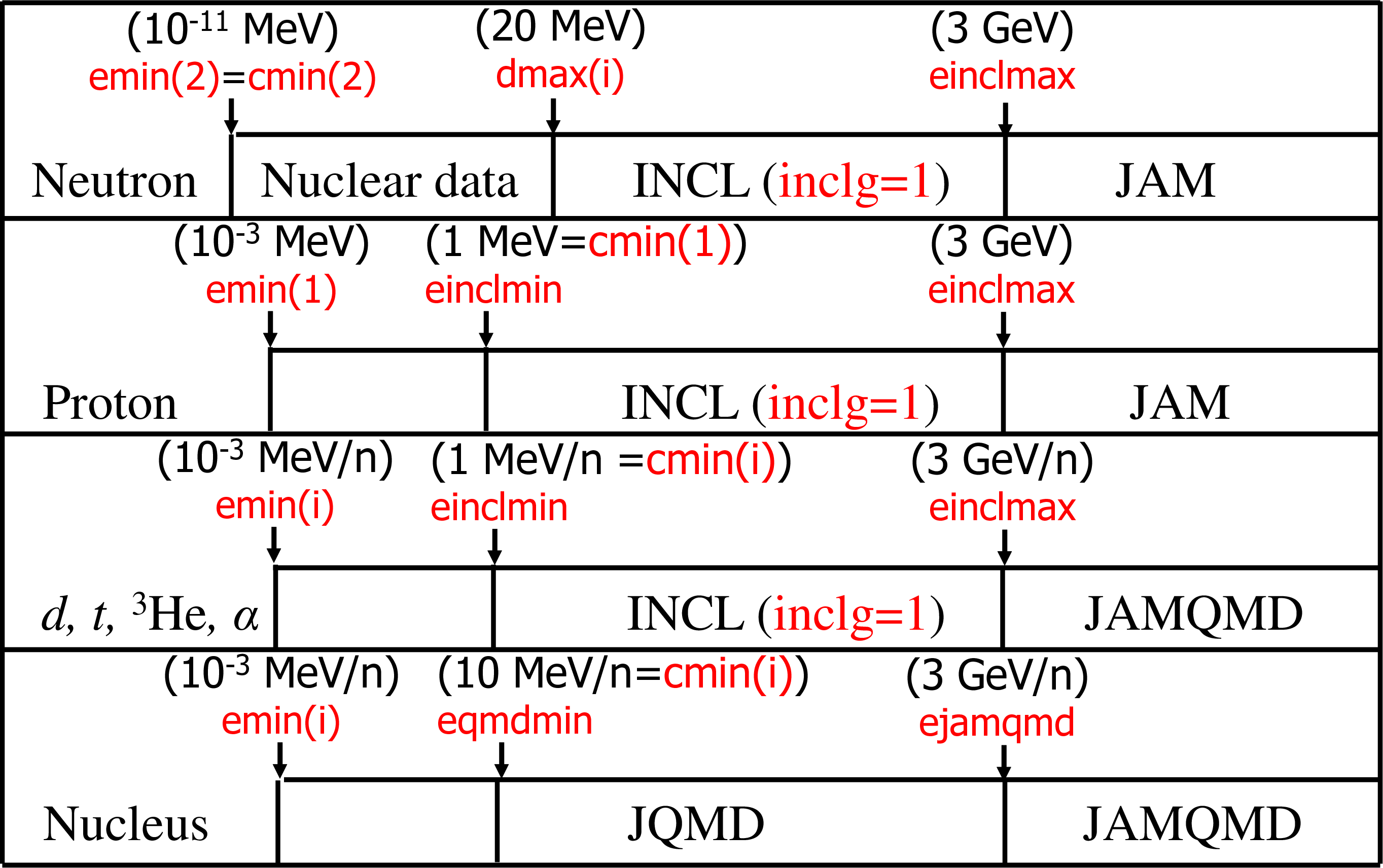
Fig. 5.2.1 Map of Nuclear Reaction Models.
INCL (Intra-Nuclear Cascade of Li`ege) is a nuclear reaction model for nucleon (proton and neutron), pion, and light-ion ( \(d, t, ^3\) He, or \(\alpha\) ) induced reactions. From version 2.50, INCL is used by default for these reactions if the nuclear reaction model is not explicitly specified. Before using INCL results in a publication, please refer to reference [2].
Intra-Nuclear Cascade with Emission of Light Fragment (INC-ELF) is a nuclear reaction model for proton, neutron, and \(\alpha\) induced reactions. Before using results obtained by INC-ELF in a publication, please refer to reference [3].
JQMD and JQMD-2.0 are nuclear reaction models; in particular, they can be used to describe heavy-ion induced reactions. In PHITS Ver. 2.7 and later, JQMD-2.0 can be used as an alternative to the conventional JQMD. JQMD-2.0 [4] describes reactions - particularly peripheral collisions - more reasonably than JQMD. Users should note that JQMD-2.0 may take more than twice the CPU time required by JQMD.
Value |
Explanation |
(D=0)
|
Option of SCINFUL mode which uses cross section database contained in SCINFUL-QMD for neutron-carbon reaction between 0.1 and 150 MeV.
|
=0
|
SCINFUL-QMD cross section database is not used (use nuclear reaction model).
|
=1
|
SCINFUL-QMD cross section database is used. In this case, [data max] section must be defined in order to decrease the maximum library energy for neutron-carbon reaction down to 0.1 MeV. Please see utility\usrtally\scinful-qmd in more detail.
|
Value |
Explanation |
(D=-1)
|
Neutron data library option for producing light ions (p,d,t,3He, \(\alpha\) ).
|
=-1
|
Produce the light ions in neutron-induced reactions only at energies between 20 MeV and dmax(2).
|
=0
|
Do not produce the light ions in neutron-induced reactions at energies below dmax(2).
|
=1
|
Produce the light ions in neutron-induced reactions at energies below dmax(2).
This option is valid for neutron induced reactions without e-mode. This option does not work if the used nuclear data do not include production reaction cross sections [5] for light ions. Neutron kerma factors (heating numbers) depend on this option and decrease in magnitude with the contributions of the productions.
|
Value |
Explanation |
(D=10.0)
|
Energy for calculating the pseudo reaction cross section to determine the flight path of charged particles when their nuclear data library is used. When a smaller value is specified for this parameter, the accuracy in calculating low-energy nuclear reactions would slightly improved, but the computational time would dramatically increase.
|
Value |
Explanation |
(D=0)
|
Option for nuclear reaction calculations when track structure mode.
|
=0
|
Nullify nuclear reaction cross sections of particles transported by track structure mode. Nuclear reactions are disregarded when KURBUC is used regardless of this parameter.
|
=1
|
Do not nullify.
|