7.15. [ T-Dchain ] section
This tally is used for generating input files for DCHAIN.
Fig. 7.15.1 illustrates the flowchart of the connection calculation between PHITS and DCHAIN.
Please see the read-me file in /phits/recommendation/dchain/ for more details of the connection procedure.
When publishing results obtained using this tally, please provide a reference to document [11].
If you want to execute DCHAIN automatically after the PHITS calculation finishes, write $DCHAIN=1 before the first section of the input file.
In that case, the file specified by file in the [t-dchain] section is automatically used as the input file for DCHAIN.
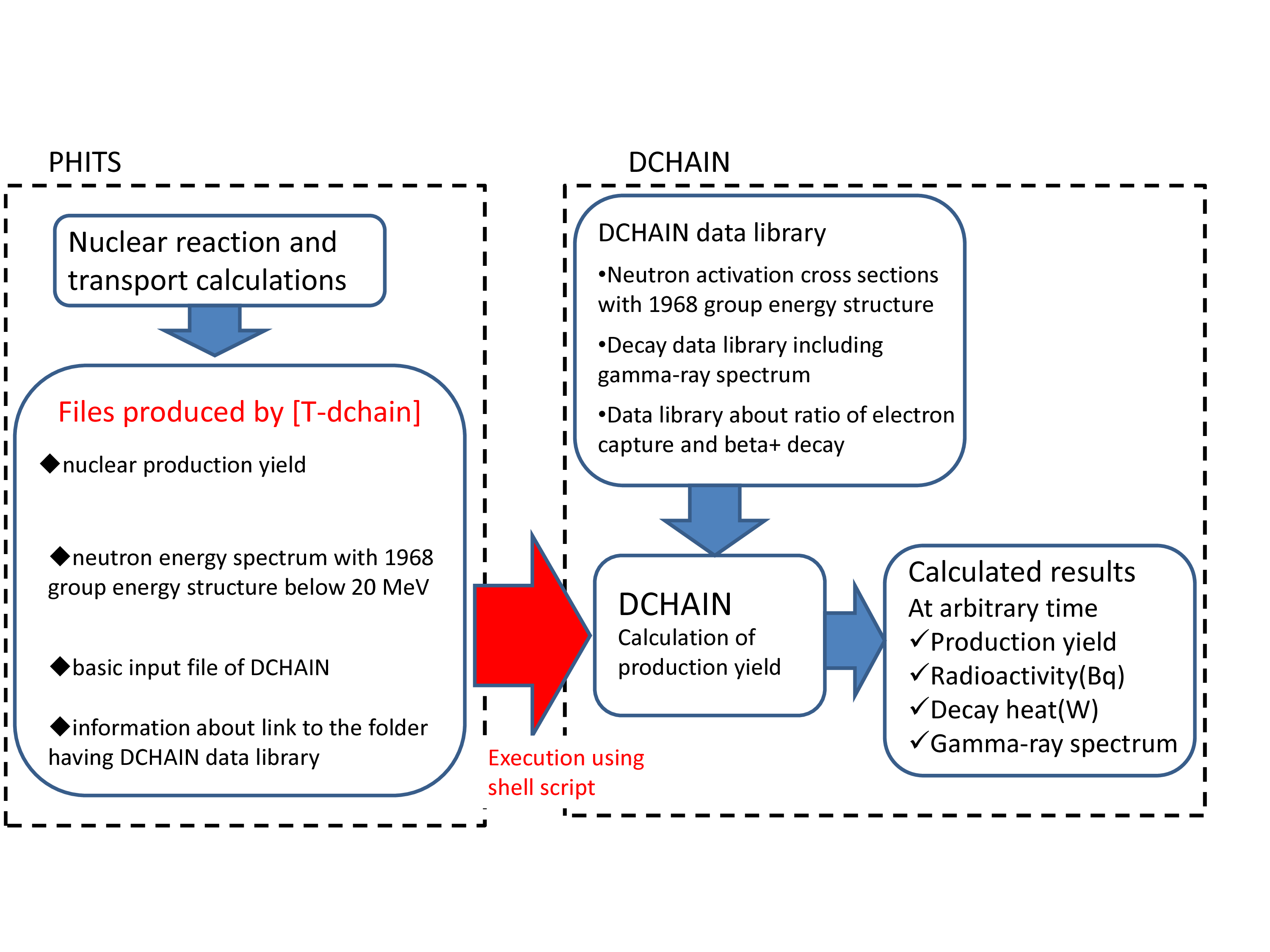
Fig. 7.15.1 Concept of the connection calculation between PHITS and DCHAIN.
In the PHITS calculation, [t-dchain] automatically creates [t-track] and [t-yield] as well as the input file of DCHAIN. The [t-track] tally calculates the neutron energy spectra below 20 MeV with a 1968-energy-group structure. The [t-yield] tally calculates the nuclear production yields by protons, heavy-ions, mesons, and neutrons with energies above 20 MeV.
In the DCHAIN calculation, the neutron energy spectra are multiplied by the activation cross section contained in the DCHAIN data library. Then, the total activations are estimated by adding these results and those directly calculated by PHITS using the [t-yield] tally. After that, DCHAIN evaluates radioactivity, nuclide, decay heat, and the gamma energy spectrum at irradiation and cooling time.
Note that the time variation in particle transport simulation or that given by time distribution defined in the [source] section is independent of the time variation in the DCHAIN calculation.
Setting e-mode>=1 in the [parameters] section enables calculation of the yields of radioactive nuclides produced by low-energy neutron reactions below 20 MeV using PHITS instead of the activation cross sections contained in the DCHAIN data library. However, the accuracy of the Event Generator mode relative to that of the DCHAIN data library in terms of calculating the residual-nuclide yields has not been verified, and it is therefore recommended that the user set e-mode=0, the default, in the PHITS calculation using [t-dchain]. Note that activations from the originally activated target are not included in the DCHAIN calculation.
From version 3.00, the natural isotope expansion defined in [material] was effective in input files of DCHAIN generated by [t-dchain]. Note that in the case that one nucleus is defined two or more times in a material, only the latter one is effective. For example, if a material is defined as follows:
MAT[1] Fe 1 56Fe 1
a contribution of 56Fe included in Fe is ignored in the DCHAIN calculation.
value |
explanation |
reg, xyz, tet |
Mesh type. Currently only reg, xyz, and tet mesh can be specified. A mesh type subsection must be added below this option. reg means cell number. |
value |
explanation |
|
Input file name of DCHAIN.
Any extension except |
value |
explanation |
(optional) |
Title. |
value |
explanation |
(optional, D=-1) |
Threshold value of STD cut off. |
When specifying stdcut, PHITS automatically stop the calculation depending on values of STD, standard deviation. This function is available when stdcut is positive and itall=0,1 is set in [parameters] section. When all relative values of STD of the tally result are larger than 0 and smaller than stdcut at the last of one batch, the calculation is stopped. If stdcut in two or more tally sections is set, all the results of the tally sections have to satisfy the conditions in order for the function to work.
value |
explanation |
0, 1, 2 (default), 3 |
Option to replace the results of nuclear reaction events with particle production cross section, activation cross section, data. 0: This option is not available. 1: Replace with cross section data in nucleon-induced reactions on \(\alpha\), \(^{14}\mathrm{N}\), and \(^{16}\mathrm{O}\) targets. 2: Replace with cross section data in a directory specified by file(27), default file(1)/XS/yield/, in proton, neutron, deuteron, alpha-induced, and photo-nuclear reactions when using the evaluated nuclear data library without e-mode. 3: Replace with cross section data in a directory specified by file(27), default file(1)/XS/yield/, in proton, neutron, deuteron, alpha-induced, and photo-nuclear reactions when using the evaluated nuclear data library with or without e-mode or nuclear reaction models. |
See Section 7.8 for ndata.
Value |
Description |
(Optional, D = 0.0) |
When the ndata option is used, this parameter specifies a scaling factor for the yield using the uncertainty ( UNC ) defined in the activation cross-section data files located in file(27) (D = file(1)/XS/yield/). |
# ZAP = 48113  LIP = 1  INT = 2  UNC = 0.5
# Elab (MeV)     sigma (b)
1.000000e-11  0.000000e+00
2.530000e-08  0.000000e+00
...
As shown above, define UNC for each reaction channel in the cross-section data files in the file(27) folder for which the uncertainty is to be evaluated. After defining UNC, setting uncfacnd scales the yield of the produced nuclide ( ZAP, LIP ) for the corresponding reaction channel by a factor of \((1 + \mathrm{UNC} \times \mathrm{uncfacnd})\). In the example above, a 50% uncertainty in the cross section ( UNC = 0.5 ) is assumed. By performing calculations with uncfacnd = -1, 0, +1, the results corresponding to the lower bound (-0.5), nominal value (no correction), and upper bound (+0.5) of the uncertainty can be obtained. By combining these three results, the impact of activation cross-section uncertainties on the yield and the subsequent radioactivity calculation can be evaluated. For the combination of results, use the analysis of variance function Section 6.9.2. The procedure described here corresponds to the three-condition method [1]. More general uncertainty propagation can also be performed by varying uncfacnd stochastically using random numbers.
value |
explanation |
0, 1 (default) |
Option to toggle between the old default format and the new much more space-efficient format for the [T-Track] and [T-Yield] tally outputs produced by [T-Dchain]. When iredufmt=0, use the old format, same as the normal format for those tallies. When iredufmt=1, use the new more space efficient format specific to [T-Dchain]. This is very strongly encouraged for large xyz and tet mesh problems. |
See Section 7.8 for ndata.
idyldmode switches how [t-dchain] evaluates the nuclide production yields.
value |
explanation |
0 (default) |
The production yield due to neutrons below 20 MeV is evaluated using DCHAIN’s own library, and everything else (protons, heavy ions, mesons, and neutrons above 20 MeV) simply follows the setting of the existing ndata parameter. See the ndata table above and Section 7.8 for details of ndata itself. |
1 |
Evaluates the nuclide production yield over the full energy range, including neutrons below 20 MeV, consistently using activation cross section data in the |
The benefit of idyldmode=1 is that it makes it easier to obtain usable statistics for reactions that occur only rarely. idyldmode=0 (the conventional internal [t-yield] approach, equivalent to ndata=2, 3) replaces the production yield with cross section data only when a nuclear reaction event actually occurs, so statistics tend to be poor for rare reactions. idyldmode=1, in contrast, accumulates the particle fluence tallied by [t-track] at every transport step and multiplies it by the cross section, so a contribution is added at every step regardless of whether a reaction actually occurred, making it easier to obtain usable statistics.
The incident particles covered by idyldmode=1 are limited to at most five species: neutron, proton, deuteron, alpha, and photon. Contributions from any other particle, such as heavy ions or mesons, are not included when idyldmode=1 is used. The existing idyldmode=0 (equivalent to ndata=2, 3) tallies the results of the evaluated nuclear data or nuclear reaction models as they are for target nuclides and incident energies not covered by activation cross section data, but with idyldmode=1, contributions from particles outside the above five species are treated as zero. If you need to evaluate activation induced by heavy ions or mesons, use idyldmode=0 instead.
If the number of produced nuclides exceeds mxnuclei (default 3000; a value larger than the compile-time upper limit is rounded down to that limit — see the description of mxnuclei in Section 7.8 for details of the parameter itself), the excess nuclides are dropped from the output entirely and only a warning is issued; the calculation itself still completes normally. Because the calculation does not stop, a nuclide that was simply truncated in this way can otherwise be mistaken for one with zero yield.
The handling of missing cross section data, file(27), is as follows. If the specified directory itself does not exist, the calculation stops with an error. If the data file for an individual (target nuclide, incident particle) pair is missing, that pair’s contribution is treated as zero and the calculation continues. If no matching data file is found at all for a material specified in the [material] section, a warning is issued but the calculation continues.
Incident energies outside the tabulated range of the cross section data, both below the minimum and above the maximum, contribute zero rather than being clamped to the nearest boundary value. Although the practical impact is usually small at the lower end of the energy range because many reactions have threshold energies, the cross sections above the upper end are often non-zero. Therefore, please note that contributions from reactions induced by incident energies above the upper limit of the cross-section data will be ignored. In the neutron-induced reaction data under phits/XS/yield/, reaction channels defined up to 20 MeV are often also included in the data blocks extending up to 200 MeV. Applying the cross section at 20 MeV to incident energies above 20 MeV may therefore overlap with the 200 MeV data and result in double counting of the same reaction components. To avoid such double counting, contributions are treated as zero when the incident energy falls outside the energy range covered by the cross-section data.
value |
explanation |
number |
Number of irradiation and cooling steps in DCHAIN calculation. |
(next line) |
time and factor. time: time step of irradiation and or cooling. factor: normalized factor for beam intensity. Time should be calculated from the end of the last step and not from the start of the first irradiation. The allowable units are seconds, s, minutes, m, hours, h, days, d, and years, y. One or more blank characters must be placed between the number indicating the time and the unit. There must also be a space between the unit and the factor. See the example of input for [t-dchain] tally below. |
value |
explanation |
number |
Number of output timings in the DCHAIN calculation. |
(next line) |
time. Output timing. If a positive value is given as the output timing, it is calculated from the start of the first irradiation step. If a negative value is given, it is calculated from the end of last irradiation step. Positive and negative values can be mixed, but to specify the end time of the last irradiation step, use a positive value for the elapsed time from the start of the calculation instead of -0. Except for this positive and negative rule, the format for specifying the timing is the same as that for timeevo. The timing cannot be specified until after all steps defined in timeevo are finished. |
value |
explanation |
(optional, D=1.0) |
Power of source, source/second. If totfact is specified in the [source] section, please adjust amp so that amp×totfact is the actual source intensity, which is in the unit of source/second. When you use the RI source with norm=0, the default setting, you should set amp=1 because the totfact factor automatically includes a factor in the unit of source/sec. |
value |
explanation |
0, 1 |
Option to manually specify the volume and nuclide densities of the target region when mesh = reg. 0: Automatic setting (the above information is read from the [material], [cell], and [volume] sections). 1: Manual setting (specify the volume and nuclide density information in the following lines according to Listing 7.15.5 ). |
This option is used when you want to perform activation calculations for a material that is different from the one defined in [material]. If you want to change the material for mesh = xyz or tet, please directly edit the DCHAIN input file generated by [t-dhcain]. Please also note that this option works correctly only for activation calculations induced by neutrons with energies below 20 MeV.
value |
explanation |
1 (default), 0 |
Toggles propagation of PHITS’s [t-yield] and [t-track] statistical uncertainties, if using iredufmt=0, yield uncertainties are separately found in the |
value |
explanation |
0, 1 (default) |
Option for the decrease of target nuclides due to spallation nuclear reaction. 0: Ignore the decrease of target nuclides due to spallation nuclear reaction. 1: Consider. |
value |
explanation |
0, 1 (default) |
Option for the decrease of target nuclides due to nuclear reaction induced by neutrons below 20 MeV. 0: Ignore the decrease of target nuclides due to nuclear reaction induced by neutrons below 20 MeV. 1: Consider. |
value |
explanation |
(D=100) |
Options for selection of neutron reaction cross section library to be used by DCHAIN. |
0, 40 |
JEFF-3.1A, DCHAIN-SP’s default from 2009-2019. |
1 |
FENDL/A-2.0, DCHAIN-SP’s default from 2001-2009. Only works with legacy simulations using the old 175-group T-Track neutron flux tallies. |
2, 20 |
JENDL/AD-2017. |
21 |
JENDL-4.0 [2]. |
30 |
ENDF/B-VII.1 [3]. |
31 |
ENDF/B-VIII.0 [4]. |
41 |
JEFF-3.3 [5]. |
50 |
FENDL/A-3.0 [6]. |
51 |
EAF-2010 [7]. |
60 |
BROND-3.1 [8]. |
70 |
CENDL-3.1 [9]. Note that isotopic data are missing for S, Cl, K, Ca, V, Zn, W, Hg, and Tl. |
90 |
TENDL-2017 [10]. Note that due to its large size, this library is available separately by request to the PHITS office. |
100 |
Hybrid library composed of, in order, JENDL-5 + JENDL-4.0 + ENDF/B-VIII.0 + JEFF-3.3 + FENDL/A-3.0. |
101 |
Hybrid library of ENDF/B-VIII.0 + JENDL-5 + JENDL-4.0 + JEFF-3.3 + FENDL/A-3.0. |
102 |
Hybrid library of JEFF-3.3 + FENDL/A-3.0 + ENDF/B-VIII.0 + JENDL-5 + JENDL-4.0. |
120 |
Hybrid library of JENDL/AD-2017 + JENDL-4.0 + ENDF/B-VIII.0 + JEFF-3.3 + FENDL/A-3.0. This was the default library before version 3.34. |
-1 |
Custom library whose name is specified with the hnxslib parameter, see DCHAIN manual for more details. |
Hybrid libraries consist of all reactions in the first listed library plus the reactions in each subsequently listed library not present in the earlier ones.
value |
explanation |
(D=5) |
Options for selection of decay data library to be used by DCHAIN. |
0 |
A hybrid library composed of evaluations and revisions from EAF-3.1, FENDL/D-1, ENSDF (1997), Table of Isotopes 8th ed. (1996), and Chart of the Nuclides 1996. DCHAIN-SP’s only decay library from 2001-2019. |
2 |
JENDL/DDF-2015. |
3 |
ENDF/B-VIII.0. |
4 |
Hybrid library of ENDF/B-VIII.0 where available and JENDL/DDF-2015 for nuclides exclusive to that library. |
5 |
Hybrid library of JENDL/DDF-2015 where available and ENDF/B-VIII.0 for nuclides exclusive to that library. |
value |
explanation |
(D=0.0) |
Threshold or cut-off value of radioactivity or inventory which must be exceeded for a nuclide to be reported in DCHAIN output. |
= 0.0 |
Threshold automatically set to the total radioactivity times \(10^{-10}\) [Bq/cm3]. |
> 0.0 |
Threshold radioactivity in [Bq/cm3]. |
< 0.0 |
-1 times the threshold inventory per unit volume in [atoms/cm^3]. |
value |
explanation |
(D=0) |
Toggle printing of stable nuclides in the output files. |
0 |
Not printed. |
1 |
Printed. |
value |
explanation |
3000 (default) |
Maximum number of nuclides to score. 0: Score the yield of all nuclides on the nuclear chart, 136 charge numbers times 236 mass numbers times 3 meta stables equals 96,288. >0: Score the yield of nuclides up to this number, and ignore the rest by outputting a warning message. A smaller mxnuclei results in smaller size of allocated memory and shorter computational time, but larger chance to miss the yields of some important nuclides. |
value |
explanation |
(D=0) |
Output option of PHITS [source] section from DCHAIN. |
0 or 1 |
No output for [source] section based on RI source. |
10 or 11 |
RI source with proj=all. |
20 or 21 |
RI source with proj=photon. |
30 or 31 |
RI source with proj=electron. |
40 or 41 |
RI source with proj=positron. |
50 or 51 |
RI source with proj=alpha. |
When the last digit of iphtout is 1, [source] based on DCHAIN’s gamma-ray database written in e-type=4 is also output.
For example both RI source with proj=all and DCHAIN database sources are generated when iphtout=11.
When iphtout is specified in a negative value, [source] sections for each output timing are separately generated in different files, |
value |
explanation |
(D=0) |
Number of nuclides shown in the EPS file generated by DCHAIN, corresponding to angelout_nucludes in DCHAIN. |
value |
explanation |
Name of nuclides shown in the EPS file generated by DCHAIN. Example: Cs-137 Ba-137m H-3 |
value |
explanation |
Region numbers shown in the EPS file generated by DCHAIN, corresponding to angelout_region in DCHAIN. |
value |
explanation |
(D=1) |
Version of DCHAIN. |
0 |
DCHAIN-SP. |
1 |
DCHAIN-PHITS. |
2 |
DCHAIN-PHITS with user-defined neutron energy bin specified in |
In addition to the above parameters, the DCHAIN parameters can also be specified in [t-dchain] section. The specifiable parameters are:
   imode, jmode, idivs, iregon, inmtcf, ichain, itdecs, itdecn, isomtr,
   ifisyd, ifisye, iyild, iggrp, ibetap, acmin, istabl, igsdef, igsorg,
   ebeam, prodnp, hnxslib, hdcylib, iwrtchn, chrlvth, iwrchdt, iwrchss,
   idosecf, ixsrall, irdonce, foamout, foamvals, ipltmode, ipltaxis
The respective meanings of these parameters, along with more detailed explanations of DCHAIN inputs and outputs, are given in the DCHAIN manual, which you can find in the /phits/dchain-sp/manual/ folder.
Note that jmode is always overridden to 0, regardless of any value explicitly specified here, when idyldmode=1 is set (see the description of idyldmode in this section for details).
     1:        mesh = reg                     <-region mesh
     2:         reg = 100                     <-cell number
     3:        file = testDC.spd              <-file name of DCHAIN input
     4:       title = [t-dchain] test calc.
     5:         amp = 1.0E12                  <-source power (source/sec)
     6:
     7:     timeevo = 4                       <-number of irradiation and cooling steps
     8:              3.0 h  1.0               <-irradiation for 3 hours
     9:              2.0 h  0.0               <-cooling for 2 hours
    10:              3.5 h  1.0               <-irradiation for 3.5 hours
    11:             15.5 h  0.0               <-cooling for 15.5 hours
    12:
    13:     outtime = 3                       <-number of output timing
    14:              3.0 h                    <-3 hours later from the 1st irradiation start time
    15:             -1.0 h                    <-1 hour later from the end of the last irradiation step
    16:             -3.0 h                    <-3 hour later from the end of the last irradiation step
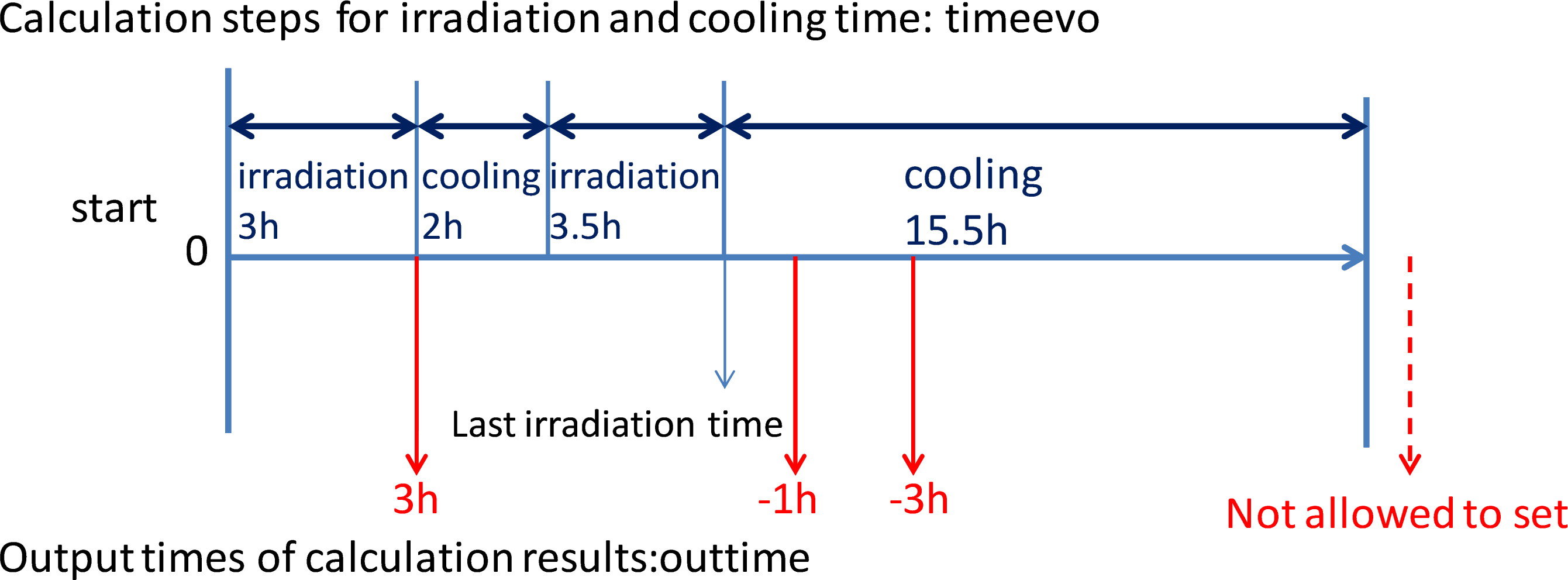
Fig. 7.15.2 Relation between steps for irradiation and cooling and output times.
                .......
      :      target = 1                       <-target material composition ON
      :      non    reg    vol                <-omissible
      :       1     1   8000.0                <-serial number, cell number, volume
      :     tg-list = 2                       <-number of the nuclides
      :             H-1   6.689E-02           <-Element ID, Atomic Number,
      :             O-16  3.345E-02             and Density of the atom (10^{24}/cm^3)
      :       2     2   2000.0                <-serial number, cell number, volume
      :     tg-list = 1                       <-Number of the nuclides
      :            Fe-56  8.385E-02
To indicate an isotope, the symbol of the chemical element must be connected with its atomic number using the character ‘-‘.
Important notices for using [t-dchain]:
The following parameters should be defined in the [parameters] section, see also a sample input in
phits/recommendation/DCHAIN/dchain.inp.file(21): set the placement of the data folder for DCHAIN. If the location of the data folder for DCHAIN is set to the default, file(1)/dchain-sp/data, you can run the calculation without specifying it.
e-mode=0: Activation calculations will be performed using a DCHAIN data library that has undergone accuracy validation.
igamma=3: Isomer production will be taken into account using the EBITEM model.
dmax(1)=200: Recommended. Nuclide production by proton irradiation up to 200 MeV is calculated using activation cross sections from JENDL-5.
dmax(2)=200: Recommended. Nuclide production by neutron irradiation up to 200 MeV is calculated using activation cross sections from JENDL-5.
dmax(15)=100: Recommended. Nuclide production by deuteron irradiation up to 100 MeV/n is calculated using activation cross sections from JENDL-5.
The volume of each tally region must be defined in the [volume] section.
Files generated by [t-dchain] are listed below.
The basic input file of DCHAIN: file name is set in the [t-dchain] tally.
Neutron energy spectra with 1968 energy groups below 20 MeV:
***.dtrkNuclear production yields:
***.dyldInformation on the link to the folder containing the DCHAIN data library is in
dch_link.dat.
Note that when DCHAIN is executed, files of names shown below are deleted.
   yield.out, out-gsdef, out-gamsporg, out-allreg, spd-act.out,
   angel-data.ang, out-phits, out-dcychains