4.3. Illustration of time input parameters
This example serves just to demonstrate how the different time-related parameters within DCHAIN/[T-Dchain] work and should be set. For the sake of this example, assume the below settings were specified in [T-Dchain]. (Note that, when written to the DCHAIN input deck, timeevo and outtime become ITSTEP and ITOUT, respectively. Additionally, by default IDIVS= 50, but it has been reduced to 5 in this example for easier visualization.)
idivs = 5

timeevo = 5
   2   h  1.0
   1   h  0.0
   1   h  0.5
   1.3 h  1.0
   1.7 h  0.0

outtime = 5
   1.3 h
   2   h
   3   h
  -0.5 h     ! (or 5.8 h)
  -1.7 h     ! (or 7.0 h)
Figure 4.3.1 presents a visualization of these input values. The important points to note are that the irradiation schedule times represent intervals of time while the output times represent exact points in time, from the start of the calculation if positive and from the end of the final irradiation step if negative. Note that output cannot be requested at times beyond the end of the final irradiation schedule interval (in this case, output cannot be requested after \(t=7\) h). A deeper explanation of the number of internal calculation steps \(N_{\text{calc steps}}\) is provided in Section 4.8.
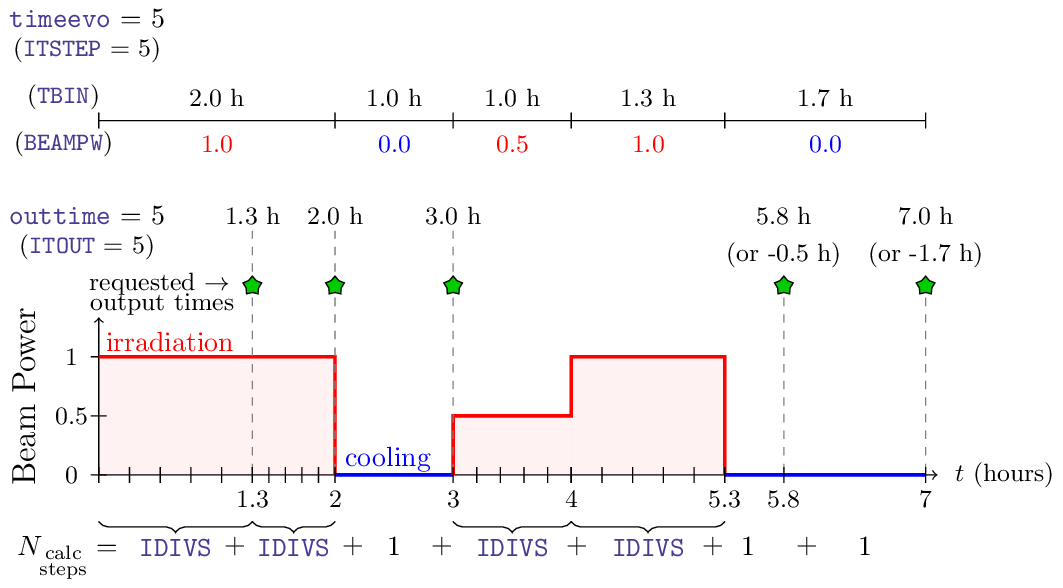
Fig. 4.3.1 Beam power schedule and requested output times are specified